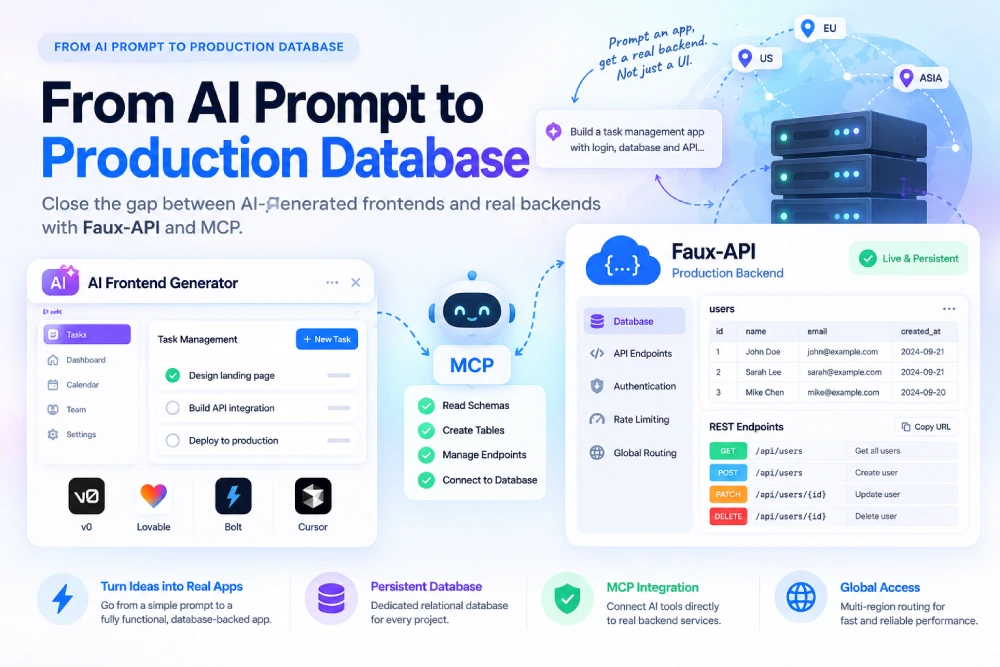
Modern AI has dramatically accelerated frontend development. With tools like v0, Lovable, Bolt, and Cursor, developers and founders can transform a natural language description into an aesthetically rich, interactive Next.js or React user interface in seconds.
Yet, many of these AI-generated interfaces stall before reaching end users. They encounter the Full-Stack Wall.
An interface relying on local component state or ephemeral browser storage is not a complete software product. The moment an application requires multi-user persistence, live database tables, secure role-based access, and reliable REST endpoints, development progress collapses back into traditional infrastructure bottlenecks. Teams spend days provisioning database clusters, configuring connection pools, wrestling with cross-origin resource sharing, and deploying custom server layers.
Here is an architectural examination of why AI frontend generation struggles with data persistence, how open protocols bridge this divide, and how Faux-API transforms static interfaces into persistent, production-ready applications with zero infrastructure drag.
The Persistent Data Dilemma in AI Development
AI coding platforms excel at visual composition, utility styling, and client-side interactions. However, without dedicated bridges to real backend infrastructure, AI models run into fundamental structural constraints:
-
Infrastructure Disconnect: AI models generate application logic, but they cannot provision or maintain the backend infrastructure required for persistent applications in isolation. Instructing an assistant to store user activity usually results in unanchored in-memory objects or unconfigured local files that vanish upon the next deployment.
-
Context Fragmentation: Maintaining complex database migrations, schema constraints, and foreign key relations across progressive code iterations strains AI context windows, frequently introducing schema drift and broken dependencies.
-
The Deployment Chasm: While modern static hosting allows instant worldwide frontend publication, spinning up a persistent backend demands hours of manual DevOps plumbing, database indexing, and environment configuration.
This friction reduces revolutionary AI design tools to interactive presentation layers rather than complete web products.
The Solution: Model Context Protocol (MCP) Integration
Bridging the gap between rapid interface generation and persistent databases requires a standardized communication layer. This is achieved through the Model Context Protocol (MCP).
MCP provides an open standard for connecting AI applications and agents with external tools, data sources, and services. It establishes a structured protocol that connects development environments—such as Cursor, Windsurf, Claude Code, and autonomous coding agents—directly to backend engines.
Instead of requiring developers to manually write server scaffolding, Faux-API’s Native MCP Server exposes real backend capabilities directly to the AI agent.
During active interface design, an AI assistant can:
-
Discover and inspect existing project schemas directly through MCP tool interfaces.
-
Interface with dedicated relational tables and assign data types in real time.
-
Bind frontend components directly to live REST endpoints backed by persistent database storage.
This protocol transforms the AI assistant from a frontend layout generator into a connected full-stack engineering engine.
Traditional Backend Architecture vs. The Faux-API Engine
| Operational Dimension |
Custom Backend Infrastructure |
Faux-API Production Engine via MCP |
| Database Provisioning |
Manual cloud database setup, networking, security groups |
Instant isolated relational database per project |
| Endpoint Architecture |
Custom routing controllers, validation schemas, ORM setup |
Automated, persistent REST endpoints |
| Data Durability |
Requires external connection pooling and backup schedules |
High-durability persistent relational storage |
| AI Tooling Synergy |
Manual copy-pasting of API documentation into prompts |
Two-way automated protocol binding via official MCP endpoints |
| API Routing |
Single-region server bottlenecks without manual CDN/Edge setup |
Managed routing designed to provide reliable multi-region access |
| Time to Market |
Days to weeks of infrastructure setup |
Minutes instead of days of backend configuration |
Closing the Loop: The Production Architecture
By connecting frontends directly to persistent backends via MCP, developers unlock an accelerated software lifecycle that bypasses weeks of repetitive scaffolding:
1. Unified Agent Synchronization
The developer provides the agent with the live MCP endpoint. The AI gains immediate awareness of available backend operations, relevant schemas, and backend capabilities.
2. Streamlined Schema Declaration
Rather than generating client-side placeholder data, the AI agent interacts with real persistent schemas through the protocol. A single conversational prompt coordinates real database tables with designated data types, indices, and validation rules.
3. Direct REST Binding
The interface consumes standard REST conventions (GET, POST, PUT, DELETE) served over managed routing. The client binds directly to live data sources, eliminating the need to write custom backend servers or deployment scripts.
4. Immediate Multi-User Persistence
Because records write directly to an isolated, persistent relational database, records persist across browser refreshes, multiple user accounts, and distributed client requests.
Eliminate Backend Friction and Build to Last
The promise of modern AI development has always been to build real, revenue-generating software without getting trapped in boilerplate infrastructure.
Pairing AI-generated user interfaces with a dedicated, persistent Backend-as-a-Service removes the single greatest barrier between an idea and a living software product.
Frequently Asked Questions
Q1: What is the Model Context Protocol (MCP) and how does Faux-API use it?
A: The Model Context Protocol (MCP) is an open standard that enables AI applications and coding agents (like Cursor, Windsurf, or Claude) to connect with external tools and services. Faux-API provides an official native MCP server (https://mcp.faux-api.com/mcp) that lets AI tools inspect project schemas, interface with persistent database tables, and wire up live REST endpoints directly during code generation.
Q2: Is Faux-API just a temporary testing tool or a real persistent database?
A: Faux-API is a production-ready, persistent Backend-as-a-Service (BaaS). Every project is provisioned with dedicated relational database storage, secure access tokens, and managed API routing. Records persist permanently across browser refreshes, multiple devices, and multi-user requests.
Q3: Can I connect frontends built in v0, Lovable, or Bolt directly to Faux-API?
A: Yes. Any frontend framework or AI generator that exports standard React, Next.js, Vue, or static HTML can query Faux-API REST endpoints using standard fetch or client data libraries. You simply point your frontend network requests to your dedicated Faux-API project URLs.
Q4: Do I need to build and manage a custom backend server to use Faux-API?
A: No. Faux-API replaces the need to build, containerize, and maintain custom backend servers. It provides instant persistent schemas, automated REST CRUD routes, and managed routing right out of the box, reducing backend configuration from days to minutes.

