Faux API MCP Guide
Create Apps & Websites in 60s with MCP and Single Prompts
MCP lets AI tools like Cursor, Claude, Codex, and other assistants talk to Faux API directly. That means your AI to create backends, generate data, build app or website screens, SMTP and create endpoints based on your requirements—without any manual setup.
- Works with testing APIs and production APIs
- Good for non-technical users and fast prototypes
- Built for Vue, Nuxt, React, Next.js, Svelte, and more
- Saves AI tokens because Faux API can be used as the backend directly, so the AI does not need to rebuild the backend from scratch
MCP Server URL
https://mcp.faux-api.com/mcpAdd this URL to your AI tool settings, connect to the Faux API backend, and start creating your app, endpoints or website instantly.
What Is MCP?
A simple bridge between your AI tool and Faux API
Think of Model context protocol (MCP) as a safe connection layer. Instead of explaining every technical step yourself, you connect your AI tool once and then tell it what you want. The AI can use Faux API to create data structures, build endpoints, and help your app move from idea to working product much faster.
Tell the AI what you want
You can ask AI to build a full website or app flow, or simply ask for direct API endpoints only, depending on your requirement.
Let Faux API handle the structure
The AI can create production APIs, fields, endpoints, and realistic mock data using Faux API, making setup fast and effortless.
Save tokens by skipping backend rebuilds
If Faux API is already handling the backend, the AI can focus more on app flow, pages, and UI instead of spending extra tokens generating backend code again.
Move from prompt to usable app faster
Once the AI understands your backend shape, it can also help build or connect the frontend with fewer back-and-forth steps.
How It Works
From idea to live backend in a few guided steps
The original content talks about a “60-second” workflow. We’ve summarized that idea into a practical process non-technical users can follow without getting stuck in developer language.
Connect an AI tool to the Faux API MCP server
Open your AI tool settings, add the MCP server URL, and save it so the assistant can access Faux API actions.
Describe the app in plain language
Ask for a testing API or production backend and mention the main collections, fields, or business flow you want.
Review the generated structure
Check the API names, sample data, and output shape so everything matches your use case before you continue.
Use the result inside your app builder flow
Now the same AI can help connect pages, forms, cards, listings, filters, or other frontend features to the generated backend.
Why People Use It
Choose the right Faux API flow for your project
Best for quick demos and instant idea validation
Create a fast mock API when you want to preview an app flow, test UI screens, or try prompts without setting up credentials first. For mock APIs, users do not need a token.
Best for real apps that need stable data and control
Use your project name and token when you want a proper backend with persistent data, more control, and a setup you can keep using as the app grows. In production mode, AI should ask for the project name and token.
Less setup work
No need to create APIs, schemas, or backend routing manually for every new idea.
Save tokens and AI effort
Because Faux API can power the backend directly, your AI does not need to waste extra tokens building backend plumbing from zero.
Flexible output based on need
Users can ask for a full website or app flow, or keep it simple and ask AI to create only the required endpoints.
Better speed for prototypes
Good for landing pages, dashboards, admin panels, directories, marketplaces, and other fast-moving app concepts.
Helpful for teams and solo users
Non-technical founders, designers, and developers can all use the same workflow with clearer prompts.
Flexible across frameworks
The concept works whether the frontend is being built in Nuxt, Vue, React, Next.js, Svelte, or a simpler stack.
Setup by Tool
Step-by-step MCP setup with visual walkthrough
Pick the AI tool your audience uses. Each tab shows a simple settings path, what to do there, and a visual slider-style walkthrough.
Settings -> MCP / Tools
Add Faux API MCP inside Cursor and start with one strong prompt
Cursor is usually the easiest place to show users an MCP workflow because the settings path is clear and the AI can quickly move from setup to generation.
Server Name:
mcp-faux-apiServer URl:
http://mcp.faux-api.com/mcpOpen settings
Click Settings → Tools & MCPs → Add Custom MCP, then paste the configuration and save.
Paste this configuration
{ "mcpServers": { "mcp-faux-api": { "url": "https://mcp.faux-api.com/mcp" } } }
Prompt clearly
Ask Cursor to create a testing API or a production backend for your app idea, or simply ask it to build anything—API endpoints, a full app, or even a complete website.
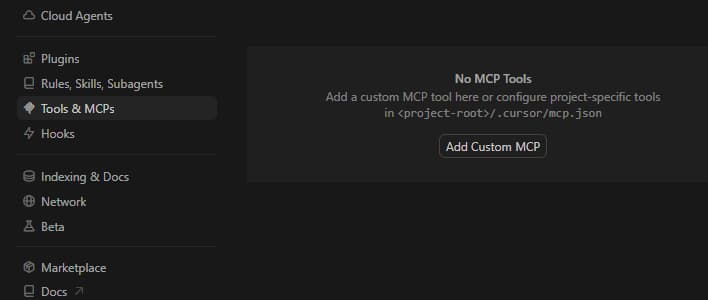
Click Settings → Tools & MCPs → Add Custom MCP
Quick Answers
Common questions from new users
What is Faux API MCP in simple words?
It is a connection that lets your AI tool talk to Faux API so the AI can help create backend structure, data, and app-ready workflows for you.
Do I need to know coding to use this page?
No. The page is written for non-technical users, so the steps focus on where to click, what to paste, and what to ask the AI.
When should I use a testing API instead of production?
Use testing when you want to prototype quickly and do not want to use a token. Use production when you need persistent data, stronger control, and a backend you plan to keep, because that flow should use your project name and token.
Which AI tools can connect to Faux API MCP?
This page currently explains setup for Cursor, Claude, Antigravity, Codex, and a general path for other AI tools that support MCP or external tool connections.
Start Faster
Connect your AI, describe your app, and let Faux API do the heavy lifting
If you want to avoid backend complexity, this page provides a simple path: connect MCP, give one clear prompt, review the result, and continue building.