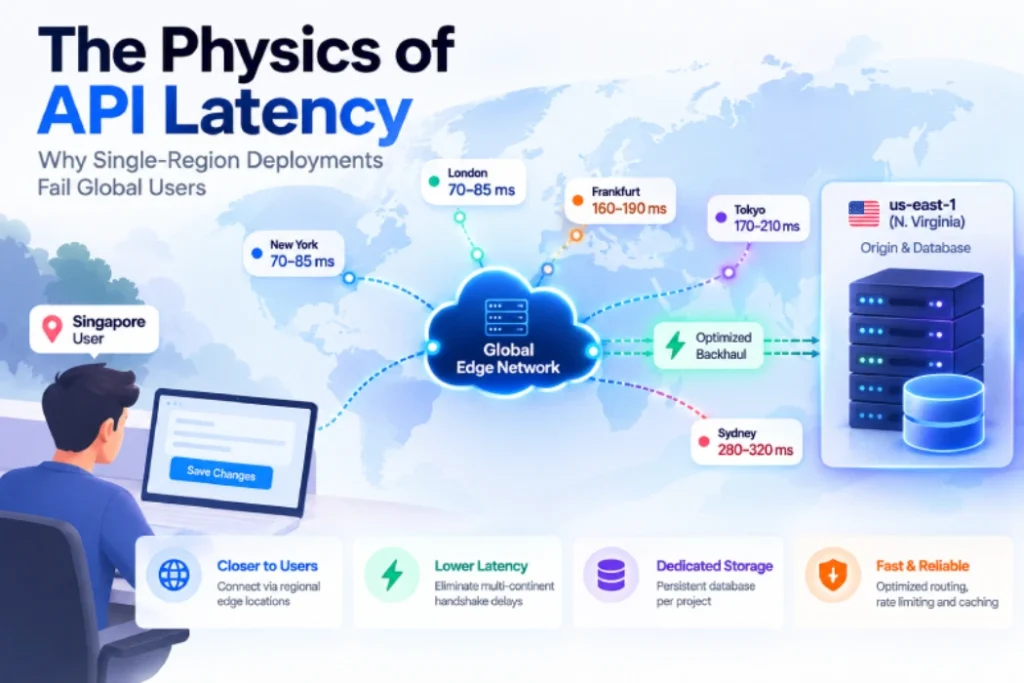
A user in Singapore clicks “Save Changes” on your web application. The frontend makes an API request to your primary backend hosted in us-east-1 (North Virginia).
Even with zero database contention, an empty query queue, and sub-millisecond application code execution, the request takes hundreds of milliseconds to complete.
The application feels sluggish not because the server code is slow, but because the architecture ignores physical distance.
Centralizing backend infrastructure in a single geographic region simplifies deployment, but it introduces an unavoidable latency tax for international traffic. Understanding how network overhead compounds across geographical boundaries—and how modern edge routing actually functions—is essential for building responsive systems.
The Anatomy of Network Overhead
Application latency is frequently misdiagnosed as an application or database layer bottleneck. In reality, the breakdown of an un-optimized remote HTTP request reveals substantial network overhead before your application logic even executes:
-
DNS Resolution: A cache miss on an uncached domain can add measurable DNS lookup latency across recursive resolvers, while locally cached lookups (at the browser, OS, or ISP resolver level) typically resolve in single-digit milliseconds.
-
TCP Handshake: Establishing an initial TCP connection requires a full round trip (SYN, SYN-ACK, ACK), adding 1 RTT.
-
TLS Handshake: TLS 1.3 requires 1 round trip to negotiate cryptographic keys and establish an encrypted session (older TLS 1.2 setups require 2 RTTs).
-
HTTP Request/Response Transmission: Sending the HTTP payload and waiting for response frames costs at least 1 full round trip, excluding server processing and wire transfer time.
On a cold connection, TCP and TLS negotiation can add multiple round trips before the application request can be processed. With connection reuse (HTTP/2 or HTTP/3 multiplexing and HTTP keep-alive), most of this initial setup cost disappears for subsequent requests. However, when users first hit your endpoints across continents, this setup penalty strikes immediately.
The Speed of Light in Fiber
Physical distance imposes a hard constraint on network performance.
Light travels through vacuum at roughly 300,000 kilometers per second. In standard single-mode optical fiber, light travels at approximately 200,000 kilometers per second due to the refractive index of silica glass (roughly 1.47).
Taking the straight-line geodesic distance between Frankfurt and Singapore (roughly 10,200 km), theoretical minimum one-way latency in glass is:
Minimum Transit Time = 10,200 km / 200,000 km/s ≈ 51 ms
A theoretical round-trip time (RTT) is approximately 102 ms.
In practice, internet traffic does not travel in a straight line. Submarine fiber tracks continental shelves, terrestrial fiber follows highway rights-of-way, and packets cross optical switches, BGP routers, and internet exchange points (IXPs).
| Route |
Approximate Distance |
Theoretical Fiber RTT |
Illustrative Network RTT Range |
| London ↔ New York |
~5,600 km |
~56 ms |
70 – 85 ms |
| Frankfurt ↔ Singapore |
~10,200 km |
~102 ms |
160 – 190 ms |
| Tokyo ↔ US-East (N. Virginia) |
~10,900 km |
~109 ms |
170 – 210 ms |
| Sydney ↔ London |
~17,000 km |
~170 ms |
280 – 320 ms |
Note: Network RTT ranges are illustrative and vary depending on upstream transit providers, peering quality, and dynamic routing conditions.
The Compounding Failure of Cascading Requests
Latency compounds quickly when frontend clients trigger sequential, dependent requests without connection reuse:
[Illustrative Sequential Chain - Tokyo Client to us-east-1 Origin]
Step 1: Auth Session Check       ~170–210ms
Step 2: Fetch User Permissions   ~170–210ms
Step 3: Load Workspace Metadata  ~170–210ms
-------------------------------------------------------------------
Cumulative Waiting Time (Network Transit Only): ~510–630ms
A user located close to the origin in North America experiences this entire sequence in under 60 ms. An international user in Tokyo or Singapore experiences a UI that stutters for over half a second before rendering primary content.
Architecture Breakdown: Edge Layer vs. Storage Layer
A common misconception in system design is conflating edge termination with database location. They solve two completely different problems.
[Global Client]
       │
       ▼ (10–20ms Local RTT)
┌──────────────────────────────────────────────┐
│ Regional Edge POP (Anycast / Reverse Proxy)  │
│  • Edge TLS Termination (Fast Handshake)     │
│  • Edge Cache (HTTP Cache-Control & TTL)     │
│  • DDoS / Rate Limiting (Redis token bucket) │
└──────────────────────┬───────────────────────┘
                       │
                       │ (Pre-warmed, persistent TCP/TLS tunnel over backhaul)
                       ▼
┌──────────────────────────────────────────────┐
│ Centralized Origin / Database Layer          │
│  • Dedicated Persistent Database per project │
│  • ACID Transactions & Data Integrity        │
│  • Connection Pooling (ProxySQL / PGBouncer) │
└──────────────────────────────────────────────┘
1. Edge Point of Presence (POP)
-
TLS Termination: The client connects to an edge proxy physically close to them (within 10–20 ms). The client’s TCP and TLS handshakes terminate here, drastically reducing time-to-first-byte (TTFB) for initial connections.
-
HTTP Caching & TTLs: For cacheable GET requests, responses are served directly from the edge cache based on the x-faux-cache: MISS/HIT headers. While the Time-to-Live (TTL) is valid, zero requests hit the origin database.
-
Header Inspection & Rate Limiting: The edge inspects authentication tokens and applies rate-limiting logic (e.g., via edge Redis caches) before forwarding traffic.
2. Persistent Origin & Database Storage
-
Read-Heavy vs. Write Reality: Cached reads return instantly from the edge. However, persistent state mutations (POST, PUT, DELETE) or uncached dynamic queries must still travel to the origin database to ensure ACID compliance and prevent data loss.
-
Backhaul Optimization: Instead of forcing the client’s device to establish a raw multi-continent TCP/TLS connection directly to the database host, the edge proxy communicates with the backend origin over a pre-warmed, persistent connection pool routed across optimized cloud backbones. This bypasses public internet packet loss and removes TCP slow-start overhead.
How Faux-API Solves Global Latency
Faux-API decouples raw client connectivity from persistent storage management through structured multi-region routing:
-
Regional Edge Ingress: Incoming client traffic terminates at geographically distributed edge points of presence, eliminating multi-continent handshake penalties.
-
Dedicated Database Storage per Project: Rather than tossing project data into a shared, volatile memory pool, Faux-API allocates dedicated, persistent database storage for every project—ensuring strong isolation, zero data wiping, and data durability.
-
Intelligent Upstream Connection Pooling: Between regional edge nodes and persistent storage instances, Faux-API maintains pre-warmed connection pools that prevent database socket exhaustion during traffic bursts.
Build with Global Physics in Mind
Minifying client bundles and tuning database indexes cannot override the physical speed of light in optical glass.
High-performance applications treat network distance as an engineering boundary. By terminating handshakes at the edge, leveraging connection pooling over dedicated backhauls, and isolating database storage per project, you can deliver consistently low-latency client connections worldwide while minimizing the distance requests travel to centralized backend infrastructure.
Deploy persistent, low-latency backends globally with Faux-API → faux-api.com
Frequently Asked Questions (FAQ)
Q1: Why does an API request feel slow if the database query executes in 2ms?
A: Database execution time measures only query runtime on the host. In cross-continent requests, network transit across physical fiber paths, DNS resolution on cache misses, and initial TCP/TLS connection negotiations frequently add 150 to 250 ms before the application logic runs.
Q2: What is the difference between an edge location and a database location?
A: An edge location is a distributed proxy node close to the user that handles DNS, terminates TLS handshakes, enforces rate limits, and caches responses based on TTL. The database location is where data is permanently stored. Edge termination accelerates connection setup, but uncached writes must still route to the persistent database.
Q3: How does connection reuse reduce network overhead?
A: On cold connections, establishing TCP and TLS requires multiple round trips. With HTTP keep-alive, HTTP/2, or HTTP/3 connection reuse, subsequent requests utilize the existing secure tunnel, eliminating the connection negotiation phase entirely.
Q4: How does Faux-API balance global edge speed with persistent data storage?
A: Faux-API routes inbound traffic through regional edge ingress nodes to terminate connections locally, while routing operations to dedicated, persistent project databases using pre-warmed connection pools over optimized network paths.

