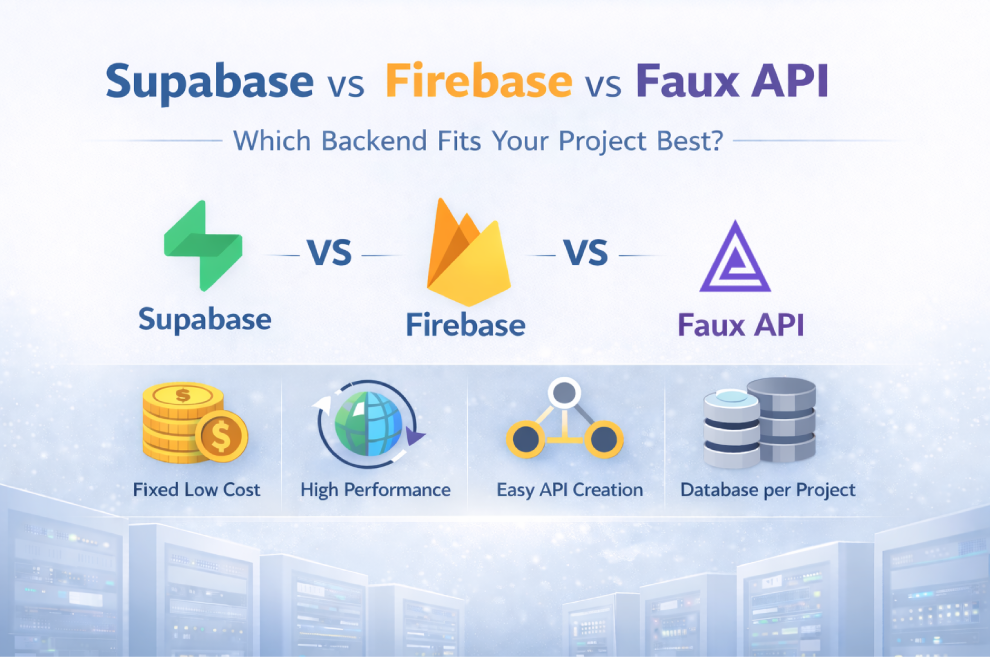
Choosing the right backend platform is not just about features—it directly impacts performance, scalability, cost, API flexibility, and security in production. Platforms like Supabase and Firebase are widely used for backend infrastructure, while Faux API focuses on delivering fast, scalable APIs with fixed low cost and simplified workflows.
Supabase is built on PostgreSQL and is best suited for applications that require structured data and SQL-based operations. It allows developers to perform complex queries, joins, and indexing, making it ideal for SaaS platforms and data-heavy applications. However, performance optimization often depends on database tuning, and caching typically needs to be configured separately.
Firebase, powered by Google Cloud, provides a NoSQL database with automatic scaling and strong real-time capabilities. It is particularly effective for mobile and live applications. However, since it is document-based, it does not support native joins, which can make handling complex relationships more challenging. Additionally, its usage-based pricing can become unpredictable as traffic grows.
Faux API takes a more modern approach by focusing on API-first backend development with production-ready capabilities. It enables teams to create APIs in under a minute without deep technical knowledge, making it highly efficient for fast development cycles. What sets it apart is its ability to handle heavy global traffic with optimized response delivery, ensuring high performance even under load.
Advanced API Capabilities and Data Handling
One of the key advantages of Faux API is how it simplifies complex data handling. Instead of writing backend logic, users can define relationships between APIs and fetch combined data in a single response. This reduces multiple API calls and improves performance, especially in ecommerce and data-driven applications, as explained in Ecommerce UX Best Practices API.
Faux API also improves development speed by enabling teams to move faster in agile environments. Instead of spending time building backend logic, APIs can be created and deployed quickly, helping teams ship faster. This workflow is described in Speed Up Agile Development with Production APIs.
API Builder and Flexible Data Structuring
To support advanced API structuring, Faux API provides a flexible builder where users can define relationships, filters, and transformations without backend code. This makes handling complex data flows simple and efficient, as detailed in API Builder Guide.
Performance Optimization with Cache Management
Performance is further enhanced through built-in caching. Responses are cached and served globally, reducing latency and improving scalability under heavy load. The working and benefits are explained in Cache Management Documentation.
Security and Access Control
Security is another critical aspect in production systems. Supabase provides row-level security, Firebase uses rules-based access control, while Faux API includes token validation and domain authorization, ensuring APIs are accessed only from trusted environments. Upcoming features like key validation and indexing will further enhance both security and performance.
Pricing and Cost Efficiency
In terms of cost, Faux API stands out by offering fixed low-cost plans along with custom pricing options, making it easier to manage budgets compared to usage-based billing systems. This predictability is especially important for applications expecting high traffic and consistent API usage.
Comparison Table
| Feature |
Supabase |
Firebase |
Faux API |
| Backend Type |
SQL (PostgreSQL) |
NoSQL (Firestore) |
API-first backend platform |
| Pricing Model |
Tiered + usage-based |
Pay-as-you-go |
Fixed low cost + custom plans |
| Cost Predictability |
Medium |
Low |
High (predictable pricing) |
| Performance |
DB optimization required |
High (Google infra) |
High (global optimized API delivery) |
| Scalability |
Manual + DB scaling |
Automatic |
Built for heavy API load |
| Database per Project |
Yes |
Yes |
Yes |
| API Creation |
Setup required |
SDK/functions |
< 1 minute API creation |
| Ease of Use |
Technical |
Moderate |
Non-technical friendly |
| Join Operations |
SQL joins |
Not supported |
Multi-API joins (single response) |
| Filtering & Transform |
Query-based |
Limited |
Built-in |
| Cache Management |
Manual |
Limited |
Automatic + global cache |
| Security |
RLS policies |
Rules-based |
Token validation + domain authorization |
| Vendor Lock-in |
Low |
High |
Low |
| Custom Plans |
Limited |
Limited |
Flexible custom plans |
| Support |
Docs/community |
Docs/support |
Live chat support |
| Upcoming Features |
— |
— |
Key validation, indexing |
Conclusion
Supabase is a strong choice for applications that require structured data and SQL control, while Firebase is ideal for real-time applications with global scaling. However, if your priority is fixed low cost, fast API creation, global performance, built-in caching, advanced data handling, and strong security with token validation and domain authorization, Faux API provides a more efficient and production-ready backend solution.

