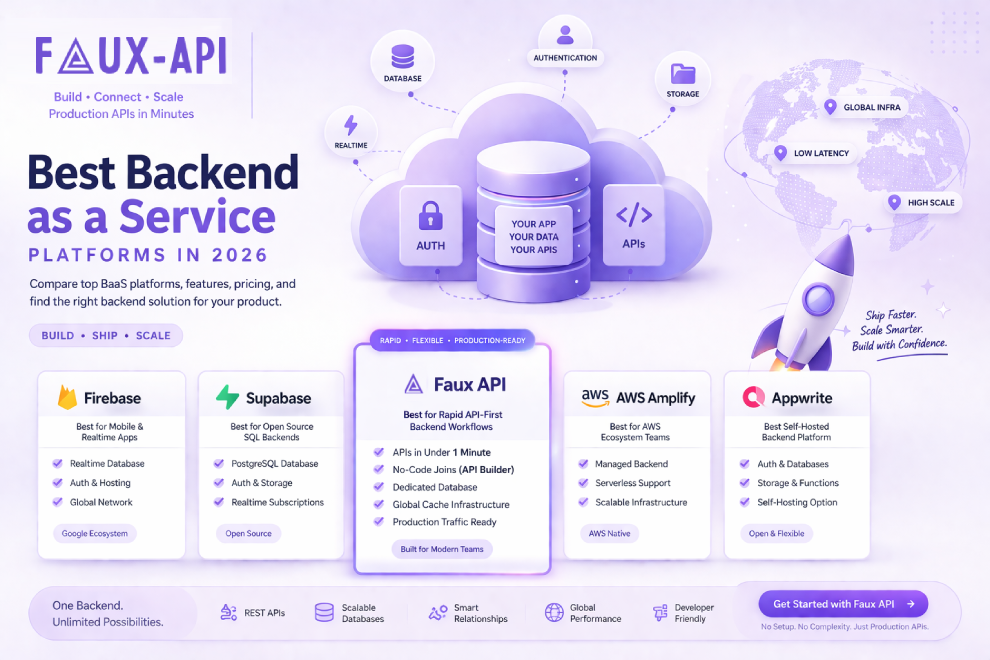
Building a startup in 2026 means shipping fast without spending months creating backend infrastructure. Backend as a Service (BaaS) platforms help startups launch quicker by providing hosted databases, APIs, authentication, and scalable infrastructure out of the box.
This guide compares the best backend as a service platforms for startups, including traditional BaaS providers and modern API-first backend platforms.
What to Look for in a Backend as a Service Platform
When choosing a backend platform, startups should evaluate:
Faux API — Best for Rapid Production API Creation & API-First Backend Workflows
Faux API is a backend platform designed for teams that want production-ready APIs quickly without managing traditional backend infrastructure.
Why Startups Choose Faux API
1. Create APIs in Under 1 Minute
Faux API allows developers to generate production-ready APIs in minutes. Once configured, endpoints are served instantly using your production URL format:
https://servefaux-api.com/{tokenNo}/{endpointName}
This removes the need for traditional backend setup and deployment pipelines.
2. Dedicated Database Per Project
Every project receives its own isolated hosted database, making scaling and project separation cleaner for growing applications.
3. API Builder With No-Code Joins
Using the API Builder, teams can connect multiple APIs into a single nested response without writing backend logic.
Examples:
-
Categories → Products
-
Users → Orders
-
Blogs → Authors
This reduces frontend overfetching and API waterfall problems.
Related guide: API Builder Guide
4. Global Cache Infrastructure for Production Load
Faux API uses globally distributed caching to deliver low-latency API responses worldwide.
Cached responses are served from locations nearest to users instead of a single origin region, improving response times across global markets.
Related guide: Cache management
5. Automatic Cache Purging
Cache is automatically invalidated when:
This ensures data freshness while preserving performance.
How Faux API Delivers Global Performance at Scale
Faux API’s distributed cache layer serves cached API responses from geographically optimized edge locations.
That means:
-
A user in London gets low-latency responses
-
A user in New York gets similarly optimized speed
-
A user in Asia avoids unnecessary origin-region round trips
This architecture helps maintain fast response times globally while reducing backend/database load.
You can test global response performance using: Global Performance Checker
Traditional BaaS Workflow vs Faux API Workflow
| Traditional BaaS Workflow |
Faux API Workflow |
| Define Database Schema |
Define Data Structure |
| Configure Auth Rules |
Configure Access Controls |
| Write Backend/API Logic |
Generate API Instantly |
| Handle Joins in Frontend |
Build Joins in API Builder |
| Deploy Backend |
Copy Production URL |
Faux API removes multiple backend setup steps, helping startups ship faster.
Built to Scale Beyond MVP Stage
Many startup teams choose backend platforms for MVP speed but later worry about scaling.
Faux API is designed to support growth with:
-
Dedicated database per project
-
Isolated project infrastructure
-
Global cache layer for heavy read traffic
-
Production traffic support
This architecture helps prevent noisy-neighbor issues where another project’s traffic impacts your performance.
Example: Build Complex API Responses Without Backend Logic
Traditional backend platforms often require developers to manually write aggregation logic when combining related data across multiple endpoints.
With Faux API’s API Builder, you can:
-
Create an endpoint normally
-
Select multiple existing APIs to include under that endpoint
-
Use drag-and-drop controls to define how the final response should be structured
-
Generate nested/combined production responses without writing backend aggregation code
1. Traditional Approach
const post = await fetch('https://serve.faux-api.com/tokenno/posts');

const author = await fetch('https://serve.faux-api.com/tokenno/users');

const comments = await fetch('https://serve.faux-api.com/tokenno/comments?post=1');
2. With Faux API API Builder
const post = await fetch('https://serve.faux-api.com/tokenno/blog-post-full');
That endpoint can return:
—all structured exactly how you configure it in the builder.
This reduces frontend complexity, eliminates API waterfalls, and gives teams full control over response shape without backend code.
Learn more about configuring joins and response structure: API Builder Guide
2. Supabase — Best for Open Source SQL Backends
Supabase offers PostgreSQL-based backend infrastructure with authentication, storage, and realtime subscriptions.
Best For: Teams wanting SQL + open-source flexibility
3. Firebase — Best for Mobile & Realtime Applications
Firebase remains a popular BaaS for realtime and mobile-focused applications.
Best For: Mobile-first and realtime-heavy apps
4. AWS Amplify — Best for AWS Ecosystem Teams
Amplify works well for startups already invested in AWS services.
Best For: AWS-native stacks
5. Appwrite — Best Self-Hosted Backend Platform
Appwrite offers self-hosted backend capabilities for teams wanting infrastructure control.
Best For: Teams preferring self-hosting
Backend as a Service Platform Comparison
| Platform |
Hosted Database |
Production APIs |
Global Infra |
No-Code API Builder |
Best For |
| Faux API |
Yes |
Yes |
Yes |
Yes |
Rapid API-first backend workflows |
| Supabase |
Yes |
Yes |
Yes |
Limited |
SQL/Postgres apps |
| Firebase |
Yes |
Yes |
Yes |
No |
Mobile/realtime apps |
| AWS Amplify |
Yes |
Yes |
Yes |
No |
AWS-native teams |
| Appwrite |
Yes |
Yes |
Depends |
No |
Self-hosted backends |
Which Backend as a Service Platform Should You Choose?
Choose based on your priorities:
-
Need production APIs fast: Faux API
-
Need Postgres backend: Supabase
-
Need realtime mobile backend: Firebase
-
Need AWS integration: Amplify
-
Need self-hosting: Appwrite
Final Thoughts
The best backend as a service platform depends on your startup’s requirements, but for teams prioritizing speed, production-ready APIs, API flexibility, and infrastructure simplicity, Faux API is a compelling choice.
Its combination of dedicated databases, no-code API joins, global cache infrastructure, and production traffic support makes it particularly strong for startup teams building and scaling quickly.
Get Started Free: Sign Up Now

